Choose who your family will become

Separation can be an act of care—for yourself and for those you are connected to.

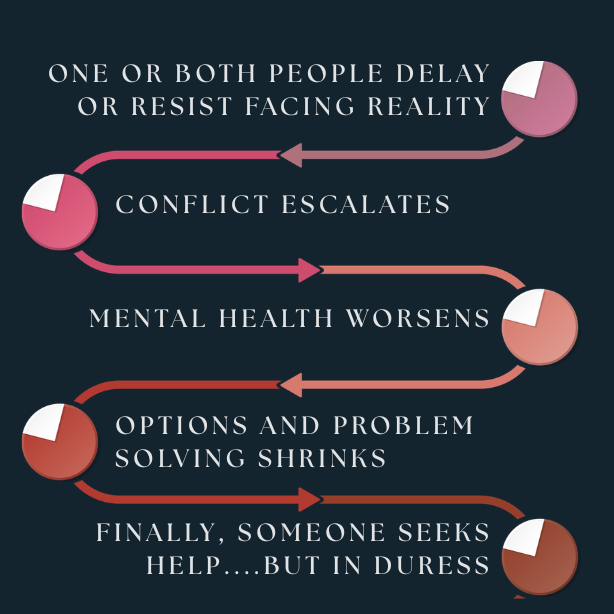
When endings arise, people often double down on their own agenda or, conversely, abandon themselves in the name of being “good.” Both responses stem from habits of disconnection and self-betrayal.

When someone appeases too quickly, ends negotiations prematurely, or entrenches in defensiveness, it’s often related to three main things:

  • losing touch with their internal compass

  • losing the endurance required to both end, and begin, new agreements

  • losing focus on what’s in the best interest of all involved.

A lack of friendship lies at the heart of many of our modern ailments. Deep loneliness is especially pernicious when couples with children decide to separate.

Our services bring people back to a grounded center. Our mediation services offer both resolution AND renewal—shaping who your family will become in sovereignty, clarity, and care.

Conflict becomes a catalyst not just for reconnection, but for relational evolution. We don’t just help you manage behavior or set schedules. We regenerate your vision for yourself and your loved ones, and foster agreement making skills that you’ll consistently utilize going forward.

While our business emphasizes family mediation and conscious uncoupling, we occasionally coach individuals to improve their agreements with an absent parent, or address agreement setting and conflict resolution in other relationships.
FAMILY MEDIATION SERVICES

What Is Developmentally-Informed Co-Parenting Mediation?

Co-parenting mediation isn’t just a legal workaround—it’s a clinically-informed process led by a PhD in clinical psychology, trained in child development, leadership and co-parenting mediation.

In this structured, neutral setting, we help parents:

Create parenting agreements without looping, wasting energy or legal escalation

Mediation provides an efficient avenue work through parenting issues with the help of a trained, neutral guide who is an expert in child development and communication. Whether it’s about holidays, routines, schooling, or unexpected changes, this process gets to the heart of the matter, shifting resistance to collaboration. The mediation session allows both parents to be heard and work toward solutions that don’t involve legal fees or courtroom stress.


Build or revise a parenting plan that fits your unique family and child

No two families are the same—and your parenting plan should reflect that.  It is quite rare for coparenting mediators to ever meet the child directly, much less provide assessment completed by a board certified child and adolescent clinical psychologist.

Whether you’re wanting to tailor a revision to meet your child’s needs, or wanting to create one from scratch, we start with a comprehensive examination of your child, assess exactly what they need in this stage of development and your specific family dynamics and values. We guide the conversation so your plan is realistic, child-centered, and responsive to your current life circumstances.

This helps you all move on from the past, prevent important things from getting lost in translation and to optimize your coparenting skills.


Stay focused on the best interests of their children,

without losing sight of yourselves.

This process will push you beyond the past so that you keep the focus where it belongs—on your children.

You’ll learn to have conversations guided by your shared interest to support your kids’ emotional, physical, and developmental well-being.

We help you make choices that create stability, confidence and clarity for your children as they adjust to life between two homes

Mediation walks you through the process to craft agreements that are ultimately best for the well being of ALL MEMBERS INVOLVED. 

We take parents who are separated or divorced through a structured mediation process that:

  • Articulates each child’s developmental needs, individual assets and resources, and specific risks/areas of concern.

  • Identifies each parent’s needs, resources, strengths, limitations and vision for their future.

  • Agree on basic approaches, activities, allowances, schedules and therapies for each child

  • Clearly articulate how the parents will communicate between each other and with their children.

  • Avoid the cost and stress of court by creating a mememorandum of understanding..

When parents separate or already live in separate homes, they often turn to the court to resolve ongoing disputes regarding custody and visitation. Families can save time, money, and the stress of a custody trial if they reach a parenting agreement. Together, we develop a comprehensive Memorandum Of Understanding. 

It’s not therapy or coaching, and it’s not legal advice—it’s a blend of assessment, mediation and teamwork that helps you move forward with clarity, respect, and support.

What Issues Are Covered in Divorce Mediations?


A separation agreement can be as broad or as detailed as you want it to be. It can be fully customized to address your family’s needs, whatever they may be. A separation agreement may dictate:

EQUITABLE DISTRIBUTION

In equitable distribution states, such as North Carolina and Florida, assets acquired and liabilities incurred during the marriage, individually by one spouse or jointly by both, are considered marital property and are subject to equitable distribution.

Mediation guides parties to make agreements on property division terms during a divorce. The goal is for both parties to take control in deciding on how assets and debts are divided versus having a judge decide.


A mediated settlement conference (conference) is a legal proceeding that is much less formal and less intimidating than a trial. The conference offers an opportunity for you to settle your case while saving you time, money, and stress involved in lengthy litigation. The mediator is there to help facilitate a discussion between those present to hopefully help them reach an agreement. Your mediator is not a judge and will not advise the parties on what action they should or should not take. Instead during the settlement conference, you, the opposing party, and any attorneys involved in your case will, with the assistance of the mediator, discuss your dispute and brainstorm possible ways to settle it.

We frequently conduct family financial settlements for couples where one, or both parties, have not retained a lawyer. These parties can prepare for mediation by understanding AND gathering financial information before the mediation process begins. LEARN MORE HERE

If you will be participating in a family financial mediation without an attorney, please be aware that while our mediator will do his or her best to ensure a civil and full discussion of the issues, s/he cannot give legal advice to anyone participating in the settlement conference.